

The pulp and paper industry is a significant sector in the global economy, known for its high energy consumption and the need for efficient heat transfer processes. Heat exchangers play a crucial role in this industry, facilitating various heating and cooling operations. Among the different types of heat exchangers available, titanium heat exchangers have emerged as a potential solution due to their unique properties. As a titanium heat exchanger supplier, I will explore whether a titanium heat exchanger can be used in the pulp and paper industry.
Understanding the Pulp and Paper Industry's Heat Transfer Needs
The pulp and paper manufacturing process involves several stages, each with specific heat transfer requirements. In the pulping stage, raw materials such as wood chips are cooked in chemical solutions at high temperatures to break them down into pulp. This process requires heating the cooking liquor, which is often acidic or contains corrosive substances. After pulping, the pulp is washed, bleached, and refined, all of which may involve heating or cooling steps. In the paper - making stage, the pulp is formed into sheets, and the water is removed through drying, which also requires heat transfer.
Efficient heat transfer is essential for several reasons. First, it helps to optimize the energy consumption of the process, reducing costs and environmental impact. Second, it ensures the quality of the final product by maintaining the appropriate temperature and chemical conditions at each stage.
Properties of Titanium Heat Exchangers
Titanium is a metal with remarkable properties that make it suitable for heat exchanger applications. One of the most significant advantages of titanium is its excellent corrosion resistance. Titanium forms a passive oxide layer on its surface, which protects it from a wide range of corrosive environments, including acidic, alkaline, and chloride - containing solutions. This property is particularly important in the pulp and paper industry, where the process fluids can be highly corrosive.
In addition to corrosion resistance, titanium has a high strength - to - weight ratio. This means that titanium heat exchangers can be designed to be lightweight while still maintaining structural integrity. A lighter heat exchanger is easier to install and requires less support, which can reduce installation costs.
Titanium also has good thermal conductivity. Although it is not as high as some other metals like copper, it is sufficient for many heat transfer applications. The thermal conductivity of titanium allows for efficient heat transfer between the hot and cold fluids in the heat exchanger.
Advantages of Using Titanium Heat Exchangers in the Pulp and Paper Industry
Corrosion Resistance
As mentioned earlier, the pulp and paper industry uses a variety of corrosive chemicals in its processes. For example, in the pulping stage, sulfuric acid or sodium hydroxide may be used, and in the bleaching stage, chlorine - based or oxygen - based bleaching agents are employed. These chemicals can cause severe corrosion to conventional heat exchanger materials such as carbon steel or stainless steel. Titanium heat exchangers, on the other hand, can withstand these corrosive environments, resulting in a longer service life and fewer maintenance requirements.
Energy Efficiency
The high strength - to - weight ratio of titanium allows for the design of more compact heat exchangers. A compact heat exchanger has a smaller volume, which means less heat loss to the surrounding environment. Additionally, the efficient heat transfer characteristics of titanium can help to reduce the temperature difference between the hot and cold fluids, leading to more efficient energy utilization.
Product Quality
In the pulp and paper industry, maintaining the correct temperature is crucial for product quality. Titanium heat exchangers can provide precise temperature control due to their consistent heat transfer performance. This helps to ensure that the chemical reactions in the pulping and bleaching processes occur at the optimal conditions, resulting in higher - quality pulp and paper products.
Types of Titanium Heat Exchangers for the Pulp and Paper Industry
There are several types of titanium heat exchangers that can be used in the pulp and paper industry.
Shell and Tube Heat Exchangers
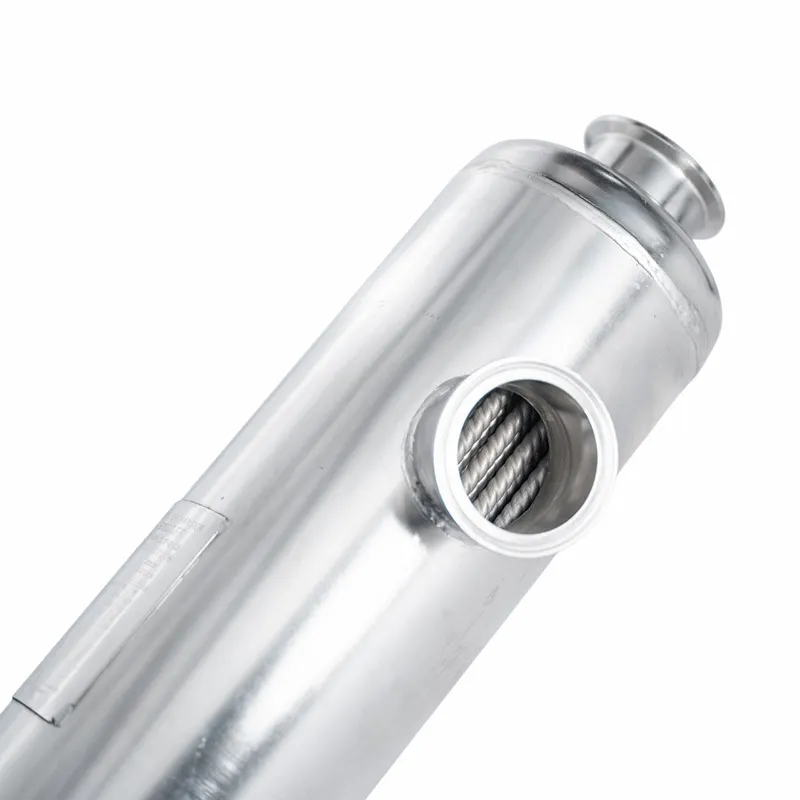
Shell and tube heat exchangers are one of the most common types of heat exchangers used in industrial applications. They consist of a bundle of tubes enclosed in a shell. One fluid flows through the tubes, and the other fluid flows through the shell. Shell and Tube Heat Exchanger for Chemical Industry is an example of a product that can be adapted for the pulp and paper industry. Titanium shell and tube heat exchangers are suitable for applications where large heat transfer areas are required, such as in the heating or cooling of large volumes of cooking liquor or pulp.
Tubular Heat Exchangers
Tubular heat exchangers are similar to shell and tube heat exchangers but are often more compact. They are made up of a series of tubes arranged in a specific configuration. Tubular Heat Exchanger can be a good choice for applications where space is limited, such as in some retrofit projects in existing pulp and paper mills.
Double Tubesheet Heat Exchangers
Double tubesheet heat exchangers are designed to prevent the mixing of the two fluids in case of tube leakage. This is important in the pulp and paper industry, especially when dealing with sensitive processes or when the process fluids are hazardous. Double Tubesheet Heat Exchanger for Medical Industry can also be customized for pulp and paper applications to ensure the safety and integrity of the heat transfer process.
Challenges and Considerations
While titanium heat exchangers offer many advantages, there are also some challenges and considerations. One of the main challenges is the high initial cost of titanium. Titanium is more expensive than traditional heat exchanger materials such as carbon steel or stainless steel. However, it is important to consider the long - term cost savings due to reduced maintenance and replacement costs.
Another consideration is the manufacturing process. Titanium is a difficult metal to work with, and special welding and fabrication techniques are required. This means that the manufacturing lead time for titanium heat exchangers may be longer than for other types of heat exchangers.
Conclusion
In conclusion, titanium heat exchangers can be effectively used in the pulp and paper industry. Their corrosion resistance, high strength - to - weight ratio, and good thermal conductivity make them suitable for the harsh and demanding environments of the pulp and paper manufacturing process. Although there are challenges such as high initial cost and complex manufacturing, the long - term benefits in terms of reduced maintenance, energy efficiency, and product quality often outweigh these drawbacks.
If you are in the pulp and paper industry and are looking for a reliable heat exchanger solution, we, as a titanium heat exchanger supplier, are ready to assist you. We can provide customized heat exchanger solutions based on your specific requirements. Please contact us to discuss your needs and start a procurement negotiation.

References
- ASM Handbook Committee, "ASM Handbook Volume 2: Properties and Selection: Nonferrous Alloys and Special - Purpose Materials", ASM International, 1990.
- Green, Don W., and Perry, Robert H., "Perry's Chemical Engineers' Handbook", McGraw - Hill Education, 2008.
- Welty, James R., Wicks, Charles E., and Wilson, Robert E., "Fundamentals of Momentum, Heat, and Mass Transfer", John Wiley & Sons, 2008.