


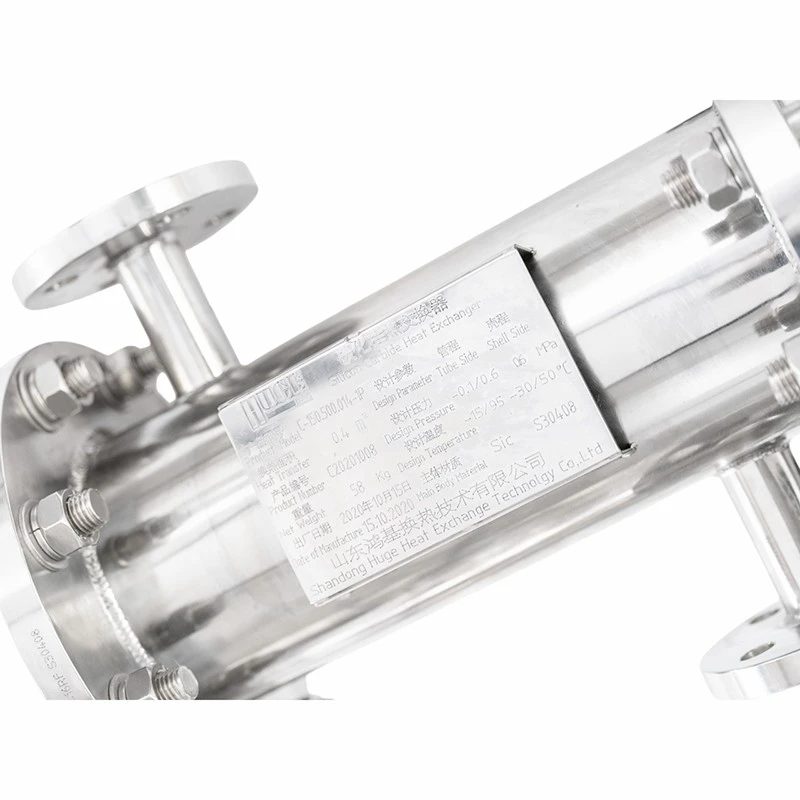

Introduction
Against the backdrop of continuous pursuit of high efficiency, energy conservation, and environmental protection in global industrial development, silicon carbide (SiC) shell and tube heat exchangers are gradually becoming one of the core equipment in chemical, power, environmental protection, metallurgy, and other fields due to their excellent corrosion resistance, high thermal conductivity, and long service life.
advantages
Core Structure Design
classic shell and tube layout
Silicon carbide tube bundle
Single silicon carbide tubes are formed using isostatic pressing technology, and parameters such as length, inner diameter, and wall thickness can be selected within a certain range to meet technical requirements, while also possessing excellent bending strength
Tube plate and shell
The tube plate adopts a silicon carbide metal composite structure, and reliable connection between the tube bundle and the shell is achieved through special sealing technology; The heat exchanger can meet the requirements of corrosion resistance and pressure resistance
Fluid distribution system
Optimized baffle design (such as bow shaped or disk shaped) creates turbulence in the shell side fluid, increasing the heat transfer coefficient by more than 30%.
Breakthrough of material performance
Corrosion resistance
Silicon carbide has almost no corrosion in strong acids, strong bases, and organic solvents with pH=0~14, and the annual corrosion rate is less than 0.01mm, far better than Hastelloy alloy (annual corrosion rate of 0.1-1mm).
Thermal conductivity
Silicon carbide has a high thermal conductivity, which is 2 times that of graphite, significantly improving heat transfer efficiency.
Mechanical strength
Compressive strength ≥ 2000MPa, Mohs hardness 9.5, able to withstand working pressure above 10MPa, avoiding wear caused by particle erosion.
Product features
core advantages
Corrosion resistance under all working conditions
Silicon carbide materials prepared by reaction sintering or chemical vapor deposition (CVD) processes can withstand extreme media such as hydrofluoric acid (HF) and molten salts, and are suitable for temperatures ranging from -50 ℃ to 650 ℃.
Efficient heat transfer and energy conservation
The high thermal conductivity of silicon carbide and the design of thin-walled tubes result in a total heat transfer coefficient which is 50% higher than graphite heat exchangers and helps enterprises reduce steam consumption by 15% to 30%.
Anti scaling and easy to clean
The surface of silicon carbide is smooth (roughness Ra<0.2 μ m) and has hydrophobicity, which can inhibit the formation of scale layers such as CaCO3 and SiO₂.
Compact design
High heat transfer area per unit volume,reducing the footprint by 40% compared to traditional equipment, making it particularly suitable for renovation projects with limited space.
Long lifespan and low maintenance
The design life exceeds 10 years, and maintenance only requires regular inspection of the seals, reducing the overall cost by 60% compared to titanium heat exchangers
Customized solutions
Support non-standard design, customizable U-shaped tube, floating head and other structures, suitable for high pressure conditions ranging 0~2MPa
Hot Tags: silicon carbide shell and tube heat exchanger, China silicon carbide shell and tube heat exchanger manufacturers, suppliers, factory, heat exchange skid, metal heat exchanger, pharmaceutical batching systems, heat exchanger, SIP System, High Temperature Oil Precise Temperature Control Skid


