

As a supplier of non - metal heat exchangers, I've often been asked about the impact of radiation on these products. In this blog, I'll delve into the science behind how non - metal heat exchangers interact with radiation and what it means for their performance and applications.
Understanding Non - metal Heat Exchangers
Non - metal heat exchangers come in various forms and materials, each with its own set of properties. For instance, we offer Shell and Tube Plastic Heat Exchanger, Immersed Plastic Heat Exchanger, and Silicon Carbide Shell and Tube Heat Exchanger. These heat exchangers are widely used in industries where corrosion resistance, lightweight design, and cost - effectiveness are crucial factors.

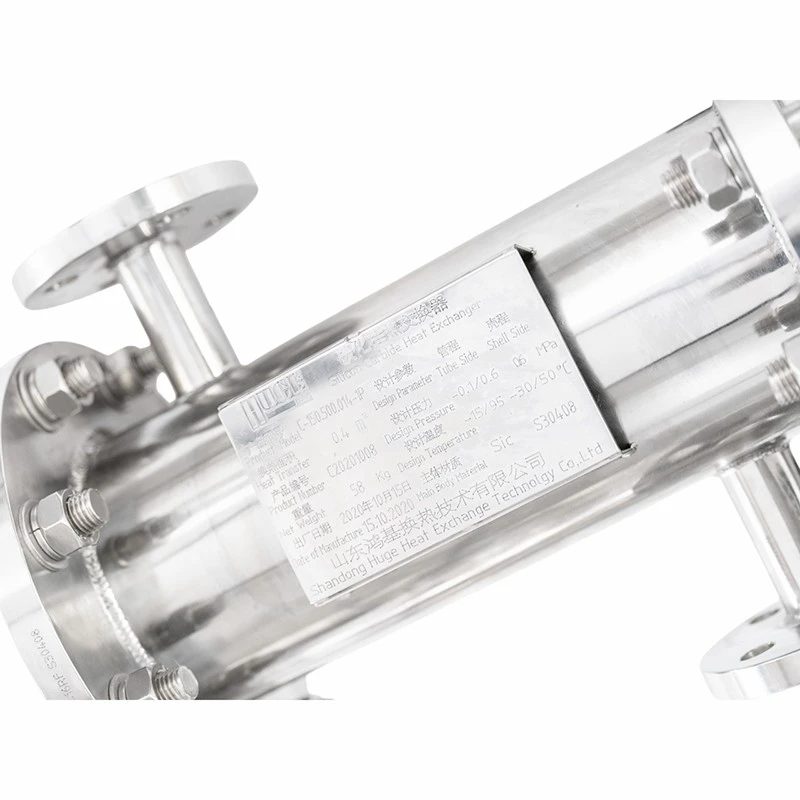
Plastic heat exchangers, made from materials like polypropylene or PVDF, are known for their excellent chemical resistance. They are commonly used in chemical processing, water treatment, and food and beverage industries. Silicon carbide heat exchangers, on the other hand, offer high thermal conductivity and can withstand high temperatures, making them suitable for applications in high - temperature processes such as waste heat recovery.
The Basics of Radiation
Radiation is a form of heat transfer that occurs through electromagnetic waves. Unlike conduction and convection, which require a medium to transfer heat, radiation can occur in a vacuum. The amount of radiation emitted by an object depends on its temperature and emissivity. The Stefan - Boltzmann law states that the power radiated per unit area of a black body is proportional to the fourth power of its absolute temperature (P = εσT⁴, where P is the power radiated per unit area, ε is the emissivity, σ is the Stefan - Boltzmann constant, and T is the absolute temperature).
When it comes to non - metal heat exchangers, radiation can have both positive and negative effects.
Positive Effects of Radiation
In some cases, radiation can enhance the heat transfer process in non - metal heat exchangers. For example, in high - temperature applications, radiation can contribute to the overall heat transfer rate. Silicon carbide heat exchangers, with their relatively high emissivity, can effectively radiate heat. This means that in a high - temperature environment, they can transfer heat not only through conduction and convection but also through radiation, increasing the overall efficiency of the heat exchanger.
Negative Effects of Radiation
However, radiation can also cause problems for non - metal heat exchangers. Plastic heat exchangers are particularly vulnerable to the negative effects of radiation. Ultraviolet (UV) radiation, which is a part of the solar spectrum, can cause degradation of plastic materials. UV radiation can break the chemical bonds in plastics, leading to a loss of mechanical properties such as strength and flexibility. Over time, this can result in cracking, embrittlement, and ultimately, failure of the heat exchanger.
In addition to UV radiation, high - energy radiation such as gamma rays can also have a significant impact on non - metal heat exchangers. Gamma rays can ionize atoms in the material, causing damage to the molecular structure. This can lead to changes in the material's physical and chemical properties, reducing its performance and lifespan.
Protecting Non - metal Heat Exchangers from Radiation
To mitigate the negative effects of radiation on non - metal heat exchangers, several strategies can be employed.
Coating
Applying a protective coating to the surface of the heat exchanger can help block radiation. For plastic heat exchangers, UV - resistant coatings can be used to prevent UV degradation. These coatings contain additives that absorb or reflect UV radiation, protecting the underlying plastic material.
Shielding
In environments where high - energy radiation is present, shielding can be used to protect the heat exchanger. Lead or concrete shields can be used to block gamma rays. However, this approach may not be practical in all applications due to the size and cost of the shielding materials.
Material Selection
Choosing the right material is crucial in minimizing the impact of radiation. Some plastics are more resistant to radiation than others. For example, PTFE (polytetrafluoroethylene) has better radiation resistance compared to polypropylene. Similarly, silicon carbide is more resistant to high - energy radiation than plastics, making it a better choice for applications where radiation is a concern.
Applications and Considerations
The impact of radiation on non - metal heat exchangers varies depending on the application.
Outdoor Applications
In outdoor applications, such as solar water heating systems or cooling towers, non - metal heat exchangers are exposed to UV radiation. Plastic heat exchangers used in these applications need to be protected with UV - resistant coatings or made from radiation - resistant materials.
Industrial Applications
In industrial settings, high - temperature processes may involve radiation. Silicon carbide heat exchangers are well - suited for these applications as they can handle the high temperatures and effectively transfer heat through radiation. However, in industries where high - energy radiation is present, such as nuclear power plants, special precautions need to be taken to ensure the long - term performance of the heat exchanger.
Conclusion
In conclusion, radiation can have a significant impact on non - metal heat exchangers. While it can enhance heat transfer in some cases, it can also cause degradation and damage to the materials. As a supplier of non - metal heat exchangers, we understand the importance of addressing the issue of radiation. By offering a range of products made from different materials and providing solutions for radiation protection, we can ensure that our customers get the best performance and lifespan from their heat exchangers.
If you are considering purchasing a non - metal heat exchanger for your application, it's important to carefully evaluate the radiation environment and choose the appropriate product. We are here to help you make the right decision. Contact us to discuss your specific requirements and explore how our non - metal heat exchangers can meet your needs.
References
- Incropera, F. P., & DeWitt, D. P. (2002). Fundamentals of Heat and Mass Transfer. Wiley.
- Holman, J. P. (2010). Heat Transfer. McGraw - Hill.