

Hey there! As a supplier of tubular heat exchangers, I've seen firsthand how the tube arrangement can have a huge impact on the performance of these essential pieces of equipment. In this blog post, I'm gonna break down the different tube arrangements and explain how they affect the efficiency, effectiveness, and overall performance of tubular heat exchangers.
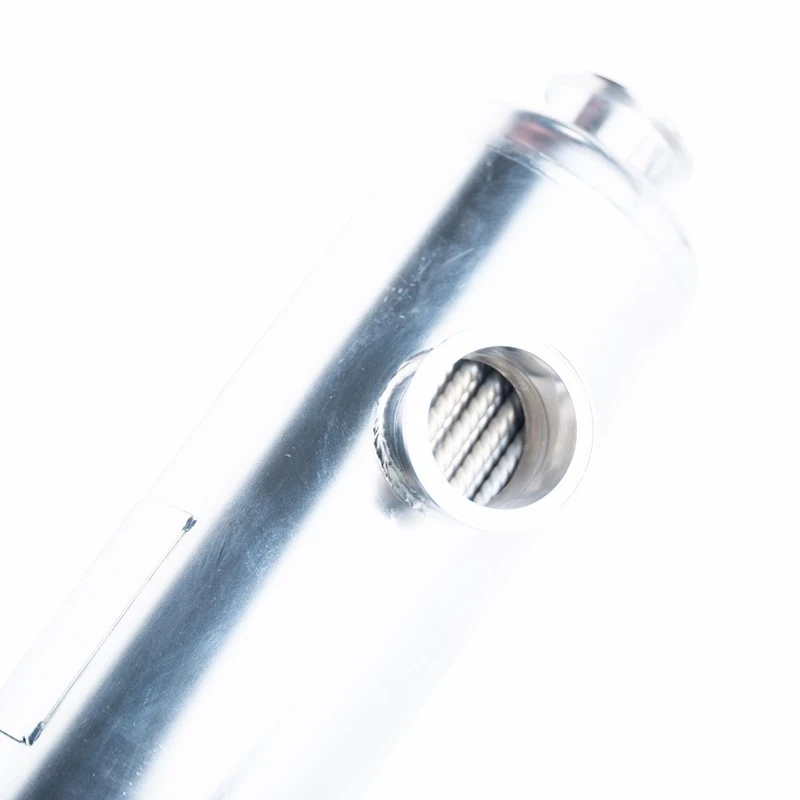

First off, let's talk about what a tubular heat exchanger is. It's a device that transfers heat between two fluids through a series of tubes. One fluid flows through the tubes, while the other flows around them in the shell. The heat is transferred from the hot fluid to the cold fluid through the tube walls. Simple, right?
Now, the tube arrangement in a tubular heat exchanger can vary in several ways, including the number of tubes, the tube pitch (the distance between the centers of adjacent tubes), and the pattern in which the tubes are arranged. These factors can all have a significant impact on the performance of the heat exchanger.
Let's start with the number of tubes. Generally speaking, the more tubes a heat exchanger has, the greater its heat transfer surface area. This means that more heat can be transferred between the two fluids, which can improve the efficiency of the heat exchanger. However, adding more tubes also increases the pressure drop across the heat exchanger, which can reduce the flow rate of the fluids and increase the energy required to pump them through the system. So, there's a balance to be struck here.
The tube pitch is another important factor. A smaller tube pitch means that the tubes are closer together, which can increase the heat transfer coefficient and improve the efficiency of the heat exchanger. However, a smaller tube pitch also increases the risk of fouling (the accumulation of dirt, debris, or other substances on the tube surfaces), which can reduce the heat transfer efficiency and increase the pressure drop. On the other hand, a larger tube pitch can reduce the risk of fouling, but it also reduces the heat transfer surface area and can decrease the efficiency of the heat exchanger.
The pattern in which the tubes are arranged can also have a significant impact on the performance of the heat exchanger. There are several common tube arrangements, including triangular, square, and rotated square.
In a triangular tube arrangement, the tubes are arranged in a triangular pattern, with each tube surrounded by six other tubes. This arrangement provides a high heat transfer coefficient and a relatively low pressure drop, making it a popular choice for many applications. However, it can also be more difficult to clean and maintain than other tube arrangements.
A square tube arrangement, as the name suggests, arranges the tubes in a square pattern, with each tube surrounded by four other tubes. This arrangement provides a lower heat transfer coefficient than a triangular arrangement, but it is easier to clean and maintain. It is also less prone to fouling, making it a good choice for applications where fouling is a concern.
A rotated square tube arrangement is similar to a square arrangement, but the tubes are rotated by 45 degrees. This arrangement provides a higher heat transfer coefficient than a square arrangement, but it is also more difficult to clean and maintain.
So, how do these different tube arrangements affect the performance of a tubular heat exchanger? Well, it really depends on the specific application and the requirements of the system. For example, if you need a high heat transfer rate and are willing to accept a higher pressure drop, a triangular tube arrangement might be the best choice. On the other hand, if fouling is a concern and you need a heat exchanger that is easy to clean and maintain, a square tube arrangement might be more suitable.
Let's take a look at some real-world examples. Suppose you're working in the chemical industry and need to transfer heat between two fluids in a process where fouling is a major concern. In this case, a square tube arrangement might be the best choice, as it is less prone to fouling and easier to clean. On the other hand, if you're working in the power generation industry and need to maximize the heat transfer rate between a hot fluid and a cold fluid, a triangular tube arrangement might be more appropriate.
At our company, we offer a wide range of tubular heat exchangers with different tube arrangements to meet the needs of our customers. Whether you're looking for a Carbon Steel Plate Heat Exchanger, a 316 Tubular Shell and Tube Heat Exchanger, or a Pharmaceutical Heat Exchanger, we can help you find the right solution for your application.
If you're in the market for a tubular heat exchanger, I encourage you to get in touch with us to discuss your requirements. Our team of experts can help you choose the right tube arrangement and other design features to ensure that your heat exchanger performs at its best. We can also provide you with a quote and answer any questions you might have.
In conclusion, the tube arrangement in a tubular heat exchanger can have a significant impact on its performance. By understanding the different tube arrangements and how they affect the efficiency, effectiveness, and overall performance of the heat exchanger, you can make an informed decision when choosing a heat exchanger for your application. So, don't hesitate to reach out to us if you need help selecting the right tubular heat exchanger for your needs.
References
- Incropera, F. P., & DeWitt, D. P. (2002). Fundamentals of heat and mass transfer. Wiley.
- Shah, R. K., & Sekulic, D. P. (2003). Fundamentals of heat exchanger design. Wiley.
- Kakac, S., & Liu, H. (2002). Heat exchangers: selection, rating, and thermal design. CRC Press.